Please attribute use to "VeterinaryClinic.com" · For custom licensing contact steve@palminteractive.com
Within minutes, interior car temperatures can reach deadly levels for pets — even on a mild day. See exactly how fast temperatures rise and what you can do to keep your pets safe.
Originally published 2012 · Updated March 2026
Please attribute use to "VeterinaryClinic.com" · For custom licensing contact steve@palminteractive.com
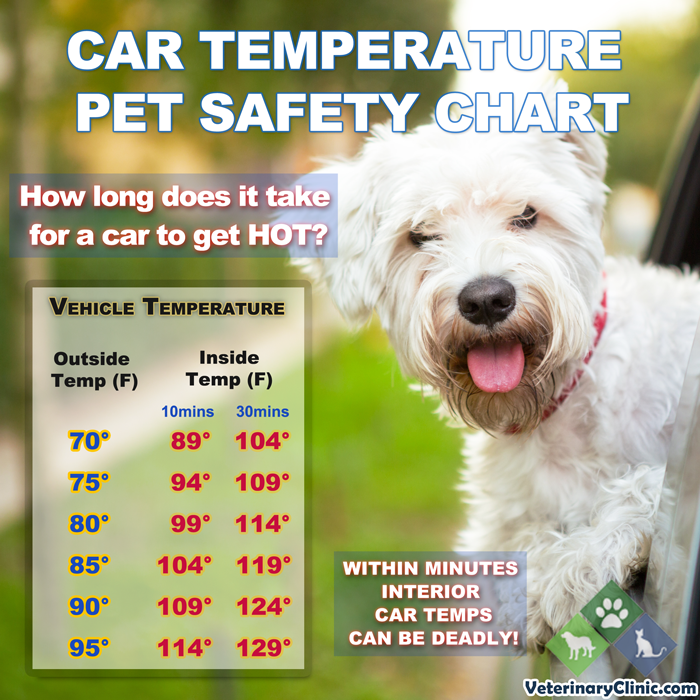
How fast interior car temperatures rise based on outside temperature. Data based on studies by the San Francisco State University Department of Geosciences.
| Outside Temp | 10 minutes | 20 minutes | 30 minutes | 60 minutes |
|---|
Even well-meaning pet owners underestimate how quickly a car becomes an oven.
On a 75°F day, the inside of a car reaches 94°F in just 10 minutes and 109°F in 30 minutes. Dogs can suffer brain damage or die at body temperatures over 106°F.
Studies show partially open windows have little to no effect on interior temperature. The greenhouse effect traps solar radiation inside the vehicle regardless.
Dogs primarily cool themselves through panting, which becomes ineffective in hot, humid, enclosed spaces. They overheat far faster than humans do.
A "comfortable" 70°F day outside means 104°F inside a parked car within 30 minutes. There is no safe temperature to leave a pet in a parked car.
Heatstroke can progress from mild to fatal in minutes. Know these warning signs.
Acting quickly can save a life. Here's what experts recommend.
Share this chart with friends, family, and your local veterinary clinic. Print it and post it at your workplace.
Download Free Printable PDF